Visit Artexpo New York April 9-12, 2026 and enjoy a rich selection of magnificent art!

The Studio at the Threshold: Three New Works from The Cosmos Series, Coming Soon
There is a particular kind of silence in the studio when a new body of work is beginning to breathe. Not the silence of emptiness, but the charged, anticipatory quiet of something becoming. Three new canvases from The Observer and the Cosmos series are currently underway, and I am writing this from inside that threshold. These works continue my investigation into the emotional and mathematical bridge between the human observer and deep space, rooted in field research at the Kennedy Space Center and anchored by the imminent Artemis II mission, where Ontario's own Jeremy Hansen will become the first non-American to leave low-Earth orbit. The studio, right now, is a response to that moment.
Margueritte Tonbazian
4/9/2026
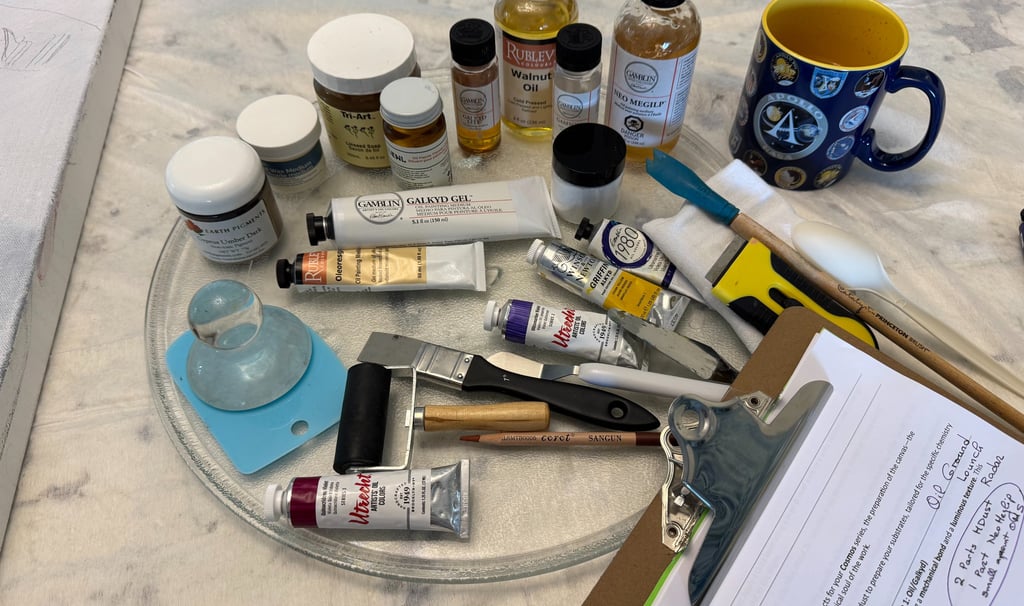
The Studio at the Threshold
Each of the three works in progress carries its own visual thesis, but they share a single question: what does it feel like to stand at the edge of what we know?
The Artemis era is not simply a space program. It is a civilizational statement, a declaration that human consciousness is not content to remain earthbound. The ratio $\phi = 1.618$, the golden mean that governs everything from nautilus shells to galactic spirals, runs through the compositional architecture of every canvas I build. It is the invisible grammar of the cosmos, and I am using it as my structural foundation.
With Artemis II now within reach, these three canvases represent the emotional weight of that anticipation, the threshold between knowing we can go, and the moment we do.
Every canvas begins as a refusal of the ordinary. Before a single mark of colour, I engineer the ground.
Marble dust is worked into the substrate to create a tactile, mineral surface, one that carries weight, that holds light the way a lunar landscape holds shadow. Over this, I build a slow, deliberate base using Neo-megilp and Galkyd, two alkyd-based mediums that give the paint film extraordinary luminosity and depth. Neo-megilp produces a soft, gel-like consistency that allows paint to move fluidly without losing body; Galkyd accelerates drying while preserving transparency, essential when you are building a surface meant to be read in layers, the way space is read in distances.
This is not a primer. It is a foundation with intention.
Colour, in my practice, is not always bought ready-made and squeezed from a tube. It is mulled, dry pigment ground by hand with walnut oil on a glass slab with glass muller until the particle size is exactly what the painting asks for. Walnut oil yellows less than linseed over time, stays flexible, and carries the pigment with a particular slowness that allows me to feel the material as I work.
ENL thinner (an odourless mineral spirit-based thinner) is introduced to adjust the working viscosity at each stage, opening the paint for atmospheric washes in early layers, then tightening as the surface builds toward resolution.
The brayer, a hard rubber roller, becomes the primary tool of application at this stage. Rather than the directional mark of a brush, the brayer presses paint into the marble dust ground, creating a compressed, almost geological surface. The result is a base that does not look painted. It looks formed.
This is where the cosmos enters.
Once the compressed ground has set, I use pipettes to drop liquid mica powder and Tri-Art iridescent paint directly onto the wet surface in controlled, deliberate falls. The pipette is not a brush, it does not direct. It releases. The mica disperses in interference patterns that shift depending on the viewer's angle, catching the light the way a planet's atmosphere refracts the sun on the edge of an orbit.
The Tri-Art iridescent medium, a Canadian paint brand, which feels particularly fitting for work rooted in the Canadian contribution to Artemis, carries fine metallic and interference particles that create what I call an atmospheric veil: a semi-translucent layer that sits above the painting's colour field like the thin edge of atmosphere seen from orbit. It gives the finished canvas a quality that photographs partially, but must be seen in person to be fully understood.
That is intentional.
Three canvases are on the studio walls right now. I won't name them yet, titles come when a work tells me it has arrived, not before. But I can tell you this: each one is exploring a different register of the same threshold. One holds the mathematics of departure. One holds the silence of orbit. One holds the question of return.
They will be released as a cohesive group. Collectors and curators who follow this series closely are encouraged to reach out directly, these works will not wait for a gallery calendar.
The Observer and the Cosmos is a finite series. Every work added is a document of this specific moment in human history, the Artemis era, the Canadian vantage, the mathematics of $\phi$. There will not be more of these later. There will only be fewer.
If this work speaks to you, I invite you to be in conversation before the works are complete. That is how collectors who care about provenance have always engaged with living artists, not after the fact, but at the threshold.